
A disabled work truck rarely affects only one driver. The vehicle may be carrying specialized tools, towing a trailer, supporting a crew, or moving materials between several projects. When it stops, appointments slide, labor sits idle, customers receive late updates, and dispatchers begin searching for a replacement vehicle or a repair facility with an open bay.
Mobile Fleet Services address that chain reaction by bringing qualified technicians, diagnostic equipment, and common replacement parts to the truck’s location. For commercial fleets, the value is not simply convenience. It is the ability to restore useful capacity without adding a tow, an extra trip, or hours of unplanned administrative work. This guide explains how on-site fleet repair works, what it costs, when it beats a traditional shop, and how to evaluate a provider before the next breakdown.
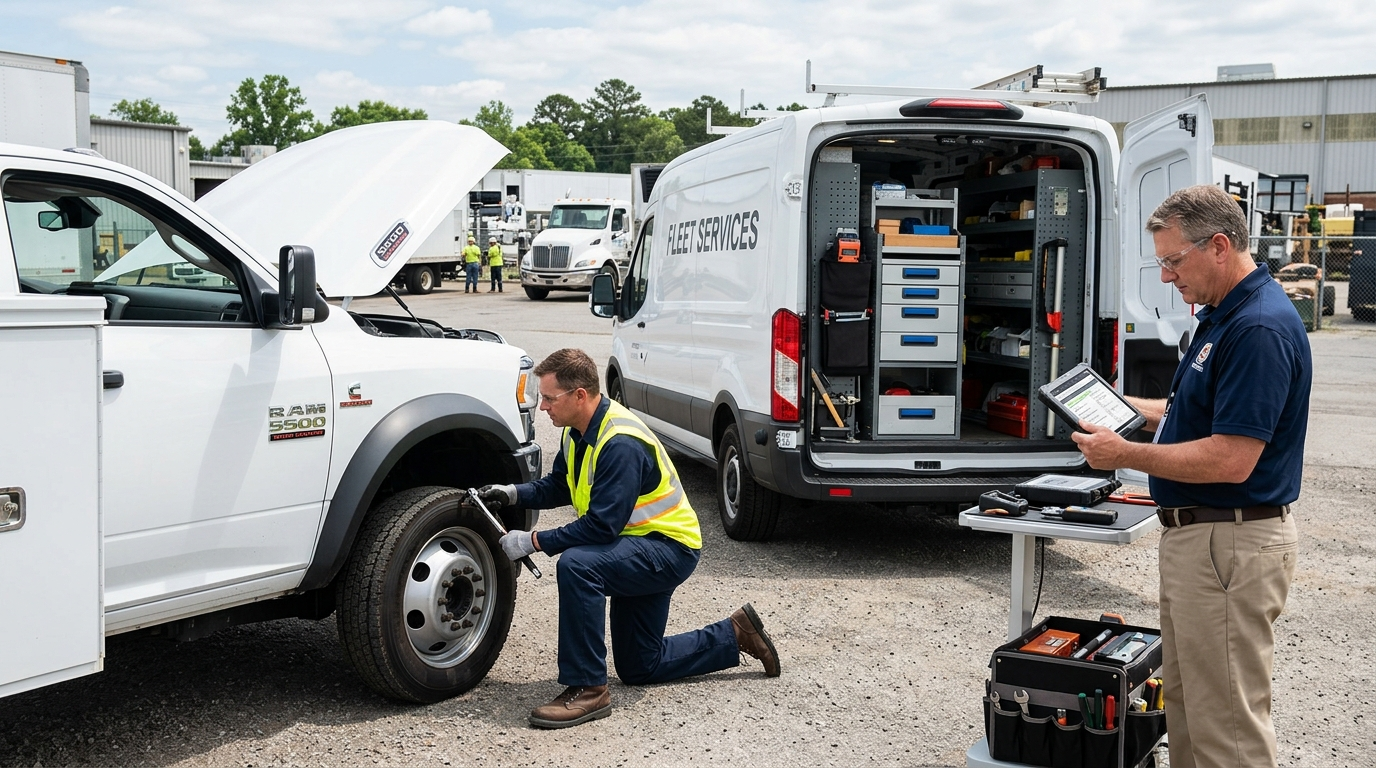
How Mobile Fleet Services Work at the Point of Failure
A mobile fleet provider dispatches a technician to a jobsite, yard, roadside location, or customer property. The technician identifies the complaint, performs a safety assessment, connects the appropriate diagnostic equipment, and determines whether the truck can be repaired where it sits. Many providers handle preventive maintenance as well as emergency repair, allowing fleets to schedule service around routes and operating hours.
The first call should provide enough information for the provider to send the right capability and parts. A vague request such as “the truck will not start” may require very different equipment than a brake warning, hydraulic leak, or engine derate.
- Provide the truck number, year, make, model, mileage, and engine type.
- Describe warning lights, noises, leaks, loss of power, and recent repairs.
- Share the exact location, access restrictions, and whether the vehicle is loaded or towing.
- Ask whether the technician can complete the repair or only diagnose and stabilize the truck.
Before authorizing dispatch, confirm the provider’s service radius, arrival estimate, diagnostic fee, and after-hours policy.
Downtime Spreads Beyond the Disabled Truck
When a single work truck in a commercial fleet breaks down, its impact depends on the vehicle’s role rather than its size. A small service van may hold the only specialized equipment needed for a same-day appointment. A dump truck or delivery vehicle may delay an entire crew, subcontractors, and material windows. The direct repair bill can therefore be smaller than the cost of missed production.
Fleet managers should estimate downtime using the operational consequences, not just the hourly wage of the driver. Track how long a truck is unavailable, whether another vehicle can substitute, and how many scheduled jobs depend on it.
| Downtime effect | Typical operational result | Management response |
|---|---|---|
| 1–3 hours | Route or appointment disruption | Dispatch mobile diagnosis and notify affected customers |
| Same day | Crew idle time or missed delivery window | Arrange a substitute vehicle or reschedule strategically |
| Multiple days | Lost capacity across projects | Approve outside rental, parts escalation, or shop repair |
Use these scenarios to set an internal approval threshold for urgent mobile repairs.
On-Site Repair Reduces the Cost of Moving the Problem
Traditional repair often begins with transportation: a tow, a driver, or a second employee must move the disabled truck to a facility. That process can consume several billable hours before diagnosis even starts. Mobile service removes much of that nonproductive movement, particularly when the defect is repairable with portable equipment and commonly stocked parts.
On-site service can be especially practical for vehicles that are difficult to tow, parked at a constrained jobsite, carrying a load, or located far from the nearest commercial repair center. It also lets a technician inspect the failure in the environment where it occurred, which may reveal operating or equipment factors that a shop visit would not.
- Fewer towing and recovery charges
- Less driver and supervisor travel time
- Lower risk of missed delivery or appointment windows
- Reduced disruption to equipment and materials already on the truck
- Faster return to service when parts and access are available
Ask the provider to separate travel, diagnostic, labor, parts, and disposal charges so the savings can be compared fairly with a shop estimate.
Preventive Mobile Maintenance Protects Daily Workflow
Emergency response is only one part of Mobile Fleet Services. Scheduled on-site maintenance can cover oil and filter changes, inspections, battery testing, lubrication, tire checks, brake assessments, fluid service, and selected repairs. A technician can service several vehicles at a yard during a planned window, reducing the number of trucks that leave productive routes for routine work.
Preventive work is most effective when it is tied to mileage, engine hours, duty cycle, and manufacturer requirements. Severe use—frequent idling, towing, dust, stop-and-go driving, or extreme temperatures—may require intervals that are shorter than a generic calendar schedule.
- Export mileage, engine-hour, inspection, and repair records from the fleet system.
- Group vehicles by type, duty cycle, and upcoming service interval.
- Reserve a yard window with safe access, lighting, and space around each vehicle.
- Require a digital service report listing work completed, defects found, and next due dates.
Start with a pilot group of high-mileage or high-consequence vehicles, then compare unscheduled downtime before and after implementation.
Mobile Service and Shop Repair Solve Different Problems
Mobile repair is not automatically better than a full-service facility. The right choice depends on urgency, diagnosis, repair complexity, location, and parts availability. A mobile technician may resolve a battery, starter, belt, hose, brake, electrical, or minor mechanical issue efficiently. A shop is usually better equipped for major engine, transmission, frame, body, machine-shop, alignment, or warranty work.
| Factor | Mobile service | Traditional shop |
|---|---|---|
| Best use | Urgent diagnosis, routine maintenance, accessible repairs | Major teardown, complex fabrication, extensive testing |
| Vehicle movement | Usually unnecessary | Truck must be driven or towed in |
| Environment | Jobsite, yard, or roadside limitations | Controlled bay and specialized equipment |
| Scheduling | Flexible for fleet windows and emergencies | Dependent on bay capacity and appointment backlog |
| Primary tradeoff | Weather, access, and parts constraints | Transport time and possible queue delays |
Have the provider define its “repair on site” limits and escalation process before an emergency occurs.
Pricing Depends on Travel, Labor, Parts, and Urgency
Mobile fleet repair pricing varies by region, vehicle class, technician specialization, and time of service. A small scheduled maintenance visit may be priced as a package, while emergency work commonly combines a dispatch or travel charge with an hourly labor rate and parts. After-hours, weekends, holidays, remote locations, and difficult access can increase the total.
Exact prices should be quoted locally, but a budget model can still help compare providers. Treat the following as broad planning ranges rather than guaranteed market rates.
| Service category | Typical planning range | Main price drivers |
|---|---|---|
| Scheduled mobile maintenance | Approximately $150–$500 plus parts | Vehicle type, checklist, fluids, number of units |
| Roadside diagnosis or minor repair | Approximately $250–$900 plus parts | Travel, diagnostic time, urgency, repair access |
| Heavy-duty or specialized repair | Approximately $500–$2,000 or more | Technician skill, equipment, parts, troubleshooting time |
Request a written estimate or not-to-exceed authorization. Also ask whether the diagnostic fee is credited toward approved repairs and whether warranty coverage applies to labor as well as parts.
Small, Mid-Sized, and Municipal Fleets Need Different Programs
A two-truck contractor does not need the same contract structure as a regional carrier, utility department, or municipal fleet. Smaller businesses may benefit from a dependable emergency contact and scheduled inspections that prevent one vehicle from becoming a single point of failure. Larger operations may need service-level agreements, centralized records, multiple technician teams, and reporting that supports compliance and budget forecasting.
- Small fleets: prioritize transparent after-hours pricing, broad coverage, and fast phone response.
- Growing fleets: seek recurring yard service, digital maintenance records, and parts coordination.
- Large or municipal fleets: evaluate geographic coverage, purchase-order workflows, uptime reporting, procurement requirements, and audit-ready documentation.
- Specialized fleets: verify experience with refrigeration units, hydraulic systems, vocational bodies, trailers, or alternative powertrains.
Do not choose solely by fleet size. A small contractor may need deep expertise in one vocational truck, while a large fleet may value consistent processes across many vehicle types.
Compliance Records Turn Repairs Into Fleet Intelligence
Maintenance records are useful for more than proving that a repair was paid. Consistent documentation helps demonstrate inspection practices, identify recurring failures, support warranty claims, and plan replacement cycles. Depending on the vehicle and jurisdiction, records may also support obligations related to commercial vehicle inspections, driver vehicle reports, brake condition, emissions systems, and regulated maintenance.
Ask for records that are detailed enough for another manager or technician to understand the vehicle’s condition. A receipt that says “service completed” is less valuable than a report showing test results, parts installed, measurements, photographs when appropriate, and the next recommended interval.
- Vehicle identification number and fleet unit number
- Date, location, mileage, and engine hours
- Complaint, diagnosis, corrective action, and parts used
- Inspection findings and safety-related defects
- Technician name or certification details
- Next service date and unresolved recommendations
Confirm that reports can be exported or integrated with the fleet management system your team already uses.
Provider Quality Is More Than a Fast Arrival Time
A quick response is valuable, but speed without accurate diagnosis can create repeat downtime. Evaluate mobile fleet providers as operational partners: check their technician qualifications, service area, equipment, parts process, communication standards, and warranty terms. References from businesses with similar vehicles and duty cycles are more useful than generic online ratings.
- Verify licensing, insurance, safety procedures, and relevant commercial vehicle experience.
- Ask what makes and systems the technicians support, including diagnostic software capabilities.
- Confirm normal and emergency response targets by location and time of day.
- Review labor rates, travel charges, minimum hours, parts markup, and cancellation terms.
- Request a sample inspection report and a clear escalation path for repairs that cannot be completed on site.
- Run a controlled service call or maintenance pilot before signing a broad contract.
For “mobile fleet services near me,” search by the actual operating area and vehicle type, then verify that the provider regularly reaches your yards and project locations rather than merely advertising a wide radius.
Clear Dispatch Rules Prevent Avoidable Delays
Even the best technician cannot work efficiently if the fleet lacks a dispatch process. Drivers and supervisors should know who may authorize repairs, what information to collect, and when a truck must be isolated or towed for safety. A simple protocol reduces duplicate calls and prevents a low-priority repair from consuming an emergency response slot.
Build a one-page breakdown procedure into driver onboarding and supervisor training. Make it accessible by phone when a vehicle is stopped at a roadside location.
- Do: move to a safe location when possible, activate hazard controls, document warning indicators, and protect the work area.
- Do: provide accurate symptoms and disclose recent modifications or repairs.
- Don’t: authorize repeated parts replacement without a documented diagnosis.
- Don’t: operate a truck with a serious brake, steering, tire, fluid, or overheating problem.
- Do: record downtime start and return-to-service times for performance analysis.
Ask your provider to help define which failures qualify for mobile repair and which require immediate recovery or shop escalation.
A Pilot Program Shows Whether the Service Pays Off
Rather than committing every vehicle immediately, test mobile maintenance and emergency response on a defined group for 60 to 90 days. Choose vehicles with frequent service needs, high utilization, or expensive downtime. Establish a baseline using the previous quarter’s repair invoices, towing charges, missed appointments, and average downtime.
Measure results consistently. A lower invoice is not the only success metric if response time improves enough to preserve a customer commitment or prevent crew idle time.
| Metric | How to measure it |
|---|---|
| Mean time to respond | Dispatch timestamp to technician arrival |
| First-visit completion | Repairs completed without a second visit or tow |
| Downtime per event | Failure report to documented return to service |
| Cost per vehicle | Labor, travel, parts, towing, and rental costs combined |
| Repeat failures | Similar defect recurring within the warranty or review period |
Use the results to negotiate service levels, adjust preventive intervals, and decide which repairs remain better suited to a traditional shop.
Frequently Asked Questions About Mobile Fleet Services
Q: Can a mobile technician repair any work truck on site?
A: No. Mobile capability depends on the defect, vehicle access, weather, parts, diagnostic equipment, and safety requirements. Major engine, transmission, frame, body, or machine-shop work usually requires a facility.
Q: Is mobile fleet repair cheaper than using a shop?
A: It can be, especially when it avoids towing, driver travel, rental costs, and lost production. However, mobile labor and emergency travel rates may be higher, so compare the complete cost of each option rather than the hourly rate alone.
Q: How quickly can Mobile Fleet Services arrive?
A: Response times vary by location, time of day, traffic, technician availability, and contract status. Ask for standard and priority targets, and confirm whether the stated time means dispatch, arrival, diagnosis, or repair completion.
Q: Do mobile providers perform preventive maintenance?
A: Many do. Services may include fluids, filters, inspections, batteries, tires, lubrication, and selected repairs. Confirm the exact checklist, supported vehicle classes, parts policy, and documentation provided.
Q: What information should a fleet manager have ready?
A: Keep the unit number, VIN, vehicle specifications, mileage, location, driver contact, symptoms, warning codes, load status, access instructions, and purchase-order or authorization requirements available.
Next Steps for Building a More Resilient Fleet
Mobile Fleet Services work best as part of a broader continuity plan, not as a substitute for maintenance discipline. Begin by identifying the vehicles whose failure would disrupt the most projects or customer commitments. Gather baseline downtime and repair data, then obtain itemized proposals from providers that understand your vehicle types and operating territory.
- Create a current asset list with mileage, duty cycle, maintenance status, and critical replacement needs.
- Define emergency authorization limits and a driver-facing breakdown procedure.
- Compare at least two providers on coverage, qualifications, pricing, records, and response commitments.
- Pilot scheduled on-site maintenance and emergency dispatch for 60–90 days.
- Review uptime, first-visit completion, total cost, repeat repairs, and compliance documentation.
The goal is not to prevent every failure. It is to shorten the path from failure to a safe, documented return to service so one disabled work truck does not hold an entire operation hostage.